Reflections from Anthropy 2026 – A Few Weeks On
The opportunity to listen and hear what was being said was initially the most important part of being at Anthropy for me. As this was my first time there, there was a conscious decision about how to show up – particularly as someone who is AuDHD, where taking time to prepare mentally helps me manage energy, avoid overwhelm and stay present in the moment.
That meant choosing to listen first, to be curious, to ask questions to build understanding and clarity and only then, where relevant, to contribute to the conversation.
Anthropy itself set the tone. The invitation to leave egos and silos at the door felt like a quiet but powerful signal – creating the space for genuine connection and collaboration, grounded in listening and hearing the intention behind other people’s voices.
Because the real value of spaces like this is not in repeating what we already know, but in discovering what we don’t.
Now, a couple of weeks on, those reflections have not faded – they have deepened. And with that comes a more important question: what happens next?

From reflection to responsibility
There’s a simple analogy I’ve heard before. Five birds are sitting on a branch and one decides to fly off.
How many are left?
Five.
Why? … … … Because deciding is not the same as doing.
It’s a reminder that the power of events like Anthropy is not just in the conversations that happen in the room, but in what follows afterwards.
And part of that sits with me – the responsibility to take action, to follow up respectfully, to ask further questions and to offer time to continue exploring where there may be genuine opportunity.
Anthropy is not just an event. It is a considered space, intentionally designed to bring people together across sectors to explore long-term challenges and opportunities for the UK. Even the choice of location at the Eden Project reflects that intention – creating an environment that naturally supports connection and new ways of thinking.
With that comes a shared intention for those attending – not only to connect and share ideas in the moment, but to carry those conversations forward in ways that can create meaningful impact over time.
It also means recognising that others may not be in the same place. The ideas that feel full of potential in my mind may not be a priority for them, or even on their agenda at all – and that is OK.
Equally, continuing a conversation may not look how it was first imagined. It may not be with the person originally spoken to, but with someone in their team or even a different part of the organisation. That is part of the process too.
The question, for me, is not just what was said – but how those conversations are carried forward, with openness, respect and realism.

The Eden Project – a space that naturally brings the Anthropy ethos to life
What became clear very quickly was that this wasn’t just about informal conversation. It was a whole ecosystem of connection and learning – talks, panel discussions, audience questions and shared thinking across many spaces, each a subtle nod to Sir Tim Smit’s vision for creating the Eden Project – a vision that, at times, may have felt impossible, yet became reality through determination, collaboration and a willingness to keep going. In many ways, that reflects the essence of Anthropy itself – bringing people and ideas together that may initially feel out of reach, yet through shared intention and action, begin to feel possible. And that was before the event had even started.
Each conversation, panel or talk built on the next. Ideas raised during a panel session would be explored further through questions, then carried into conversations and new connections afterwards. Learning wasn’t happening in isolated moments – it was evolving in real time.
Alongside that, there was an openness in the way people interacted. Smiles were shared easily, conversations happened between those sessions and people were willing to sit together, even if they had not met before. It didn’t feel transactional or forced.
That atmosphere changed how people showed up. It created a sense of ease, where conversations could begin without hesitation and develop without pressure.
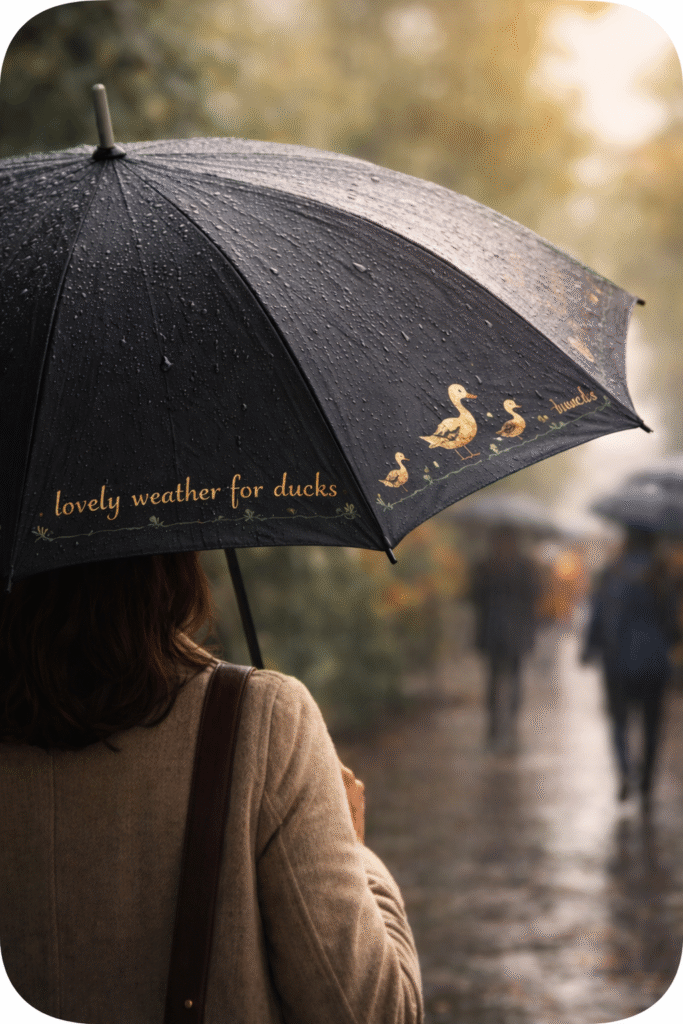
One simple moment for me captured that. Walking between sessions in the rain, umbrella up, the person behind me said, “I love your umbrella – I was just thinking it was lovely weather for ducks, and that’s exactly what yours says” – My umbrella is black and, very subtly around the edges, there’s a small family of ducks walking, with the words “lovely weather for ducks”.
Perhaps most importantly, it created the space to listen – not just to what was being said, but to the intention behind it

Real moments and connections
Some of the most valuable moments came through a combination of planned and unexpected connections.
Before Anthropy had even begun, there was already a sense of what might be possible. Sharing a post ahead of the event, outlining the work of aDoddle and an openness to connect, led to a message from Ed Leighton from The Connection Project with an invitation to join a private roundtable at Anthropy – an early indication that there was openness to exploring how different perspectives might come together, across government, organisations, business and wider society.
Another connection before Anthropy, was a member of the Anthropy team kindly introducing me by email to Dr Alison Smith from the Royal Voluntary Service (RVS) and GoVo. That early connection led to a genuinely warm welcome when we met in person at the event, and set the tone for what followed.
Hearing more about the GoVo platform highlighted the strength of what is already being developed around volunteering. For me it also prompted a line of thinking around the potential for future collaboration and connection between aDoddle, the Royal Voluntary Service and GoVo – not through duplication, but by recognising where each brings expertise. They are specialists in what they do, just as we are in what we do, and perhaps there is an opportunity to build on those strengths.
It is in that space – where expertise is respected and combined – that collaboration has the potential to add real value.
During the session United: Our Vibrant Places, a panel discussion involving Clara Govier, Managing Director at Postcode Lottery UK, and others, including Matt Hyde OBE from the Lloyds Bank Foundation, brought another perspective. The scale of support shared – over 19,000 charities – was significant, made possible by the players of the People’s Postcode Lottery.
When the opportunity came to ask a question, it felt natural to build on that, reflecting on the visibility gap and how, without a simple way for people to find and access that support, so much of that impact remains hidden. If people in the towns and cities where those charities are active do not know they exist, then those who could benefit from that support, opportunity or connection may miss out entirely.
A simple observation followed – that funders could play a role in making this visible, by encouraging or requiring organisations to create a free profile, on the aDoddle.org network of community maps, as part of receiving their grant funding.
Alongside the sessions, there were also valuable one-to-one conversations, including a fantastic meeting with Chris Smith, Head of UK Skills and Social Responsibility at Amazon, which provided an opportunity to better understand the work being done, what sits behind it and what motivates it.
Hearing about programmes such as supported internships, helping young people with learning disabilities and or autism build employability skills, stood out as a meaningful example of how large organisations can create practical opportunities that make a real difference.
In that context, I was given an opportunity to share a longer-term idea – a BHAG (Big Hairy Audacious Goal) – connected to the work we are developing through aDoddle and the growing #DoWith movement. That in turn led to an invitation to send through a simple outline, with no expectations attached, and is one of the actions I will be taking forward following the event.

The visibility gap – you can’t fix what you can’t see
Across the conversations, panels and questions, one theme kept emerging – sometimes directly, sometimes just beneath the surface.
There is a gap between the support that exists and people’s ability to find it.
We talk about strengthening communities, creating vibrant places and investing in long-term change. Yet if people cannot easily discover what is available around them – whether that is support, opportunity or connection – then a critical part of the system is missing.
Too often, support is only found once a situation has reached crisis point – whether that is through a referral into health services or a call for help in a moment of urgency. Yet the opportunity sits earlier than that. By making it easier for people to see what is already available around them, there is the potential to offer support, connection or direction before that point is reached.
This is what I describe as the visibility gap.
It is not a lack of provision. As was shared during the sessions, thousands of organisations are already doing incredible work. The challenge is that much of that work remains hidden to the people who could benefit from it most.
Without a simple and accessible way to bring this information together, people are left to navigate complexity at a time when they may already be under pressure. Too often, support is only found when options are more limited and the need has become more urgent.
The opportunity is not necessarily to build something new, but to make better use of what already exists – to create visibility, connect information and make it easier for people to find help before it is needed most

What happens next?
The talks, panel discussions, questions and shared conversations all sparked ideas, connections and possibilities.
Many moments from the sessions stayed with me.
In one discussion involving Miatta Fahnbulleh MP, Pride in Place was being discussed – a 10-year government programme with up to £5 billion of investment, supporting up to 300 neighbourhoods to strengthen communities and local pride.
A question was then raised by a member of the audience: what happens to those communities that are not part of it or have not been selected? How do they learn from what is being developed now, rather than waiting years for the outcomes?
It was a powerful reminder that the opportunity is not just in what is being built, but in how that learning is shared.
That question stayed with me and shaped how I approached my own contribution, bringing in the visibility gap – the idea that even with significant investment and activity, if people cannot easily find and access what exists, a critical part of the system is missing.
I also highlighted that there is already a UK-wide digital infrastructure in place through aDoddle that could begin to support this immediately, helping to make local support and opportunities visible and accessible at scale.
It was encouraging to hear this reflected in the closing comments, followed by a brief conversation afterwards, where there was agreement that this is something worth exploring further.
But as the analogy goes, deciding to fly is not the same as taking action.
What happens next is not always straightforward. Life happens. Priorities shift. Messages go unanswered. And it is not always clear whether that is a lack of interest, a lack of time or simply the reality of everything else people are managing.
So the question becomes how we respond to that. Do we follow up, respectfully? Do we ask permission to continue the conversation? Do we recognise that what feels important to one person may not yet be a priority for another?
The opportunity is not just in the ideas, but in how we carry them forward – with patience, with openness and with a willingness to continue listening as well as contributing.
Because the birds may still be on the branch. The question is whether, together, we choose to take the next step.

Please note:
A note on how this article was created
This article has been created and shaped by Jaki King, Founder and CEO of If Everyone Cares CIC – the organisation behind aDoddle.org and TheCommunityPledge.com.
It reflects more than 25 years of experience working in and alongside communities and over a decade of exploring community mapping, visibility and connection.
The content has also been shaped through listening to hundreds of real stories, insights and experiences shared by people, organisations and communities over time.
As part of the process, Jaki used AI as an accessibility and thinking tool to support how she works as someone who is dyslexic, autistic and has ADHD. This included helping her to structure ideas, refine wording and maintain clarity, while ensuring that the final content reflected her voice, her values and what matters in the work she does.
The article has been developed iteratively, going backwards and forwards to ensure it feels true to that.
(Time invested: approximately 5 hours from first draft to final version.)