Co-production is a term that is often used, but not always fully understood.
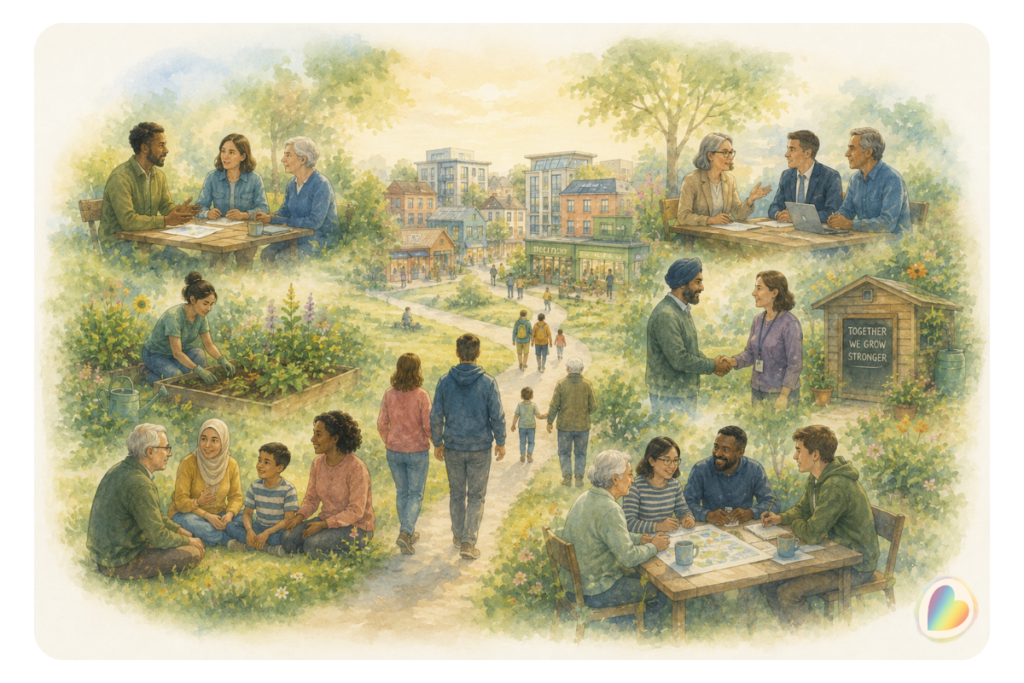
At its heart, co-production is about working with people rather than doing things to or for them. It recognises that people and communities hold valuable knowledge, insight, and lived experience that should shape the design and delivery of services, support, and opportunities.
This is the thinking that sits behind the growing #DoWith approach – a way of working that centres collaboration, shared ownership, and listening, rather than top-down design.

Sometimes the best solutions don’t come from one place
Communities are complex. People’s lives don’t fit neatly into categories, and the challenges they face are often interconnected. That means the answers don’t sit in one organisation, one service, or one perspective. They sit across communities – in the experiences, insights, and ideas of the people who live and work within them.
Some of the most effective and sustainable solutions emerge when these different perspectives are brought together. People with lived experience, community organisations, service providers, and local systems each hold part of the picture.
When these perspectives are connected, something powerful happens. Understanding deepens. Gaps become visible. New ideas begin to form.
This is where co-production becomes so important in practice. And it is where the #DoWith approach brings this to life. By working with people and organisations, rather than designing solutions in isolation, we can build on what already exists, strengthen what is working, and avoid creating parallel systems that duplicate effort.
Instead of reinventing the wheel, we create the conditions for shared learning, collaboration, and more joined-up support.
What is co-production?
Co-production is about working together.
It brings together:
- Community members
- Charities and organisations
- Service providers
- Local systems
Not just to deliver services, but to shape and improve them.
It recognises that people are not just recipients of support – they are part of the solution. #DoWith
Terms like co-design, co-creation and community participation are often used in public sector and systems conversations. However, at its heart, this is about human relationships, listening and building with people rather than designing at a distance.
Why co-production matters now
As the way people search for help and support evolves, there is a growing need for services to be:
- More connected
- More visible
- More reflective of real-life needs
Co-production helps make that possible. It ensures that services are not designed at a distance, but built with the people they are there to support.
People do not always know what to ask for, or how to describe what they need. They may be navigating multiple challenges at once, and those challenges do not fit neatly into categories.
By bringing together lived experience, community insight, and service knowledge, co-production creates a clearer, more human picture of what support looks like in practice.
This is where approaches like #DoWith become increasingly important. By working with people and communities, rather than designing at a distance, services become easier to understand, more relevant, and more likely to reach the people they are there for.
What co-production makes possible
Improved quality of services
When different perspectives come together, services are shaped by real experience – this leads to:
- A clearer understanding of need
- More relevant support
- Better outcomes for the people using those services
Increased efficiency
When services are aligned with what people actually need:
- Duplication is reduced
- Gaps become more visible
- Resources are used more effectively
This benefits not just organisations, but the whole community. It also reduces the need to constantly recreate solutions, allowing people and organisations to build on what already exists.
Greater community engagement
When people are involved in shaping services:
- They feel heard
- They feel valued
- They feel part of something
This creates stronger, more connected communities, where people are more likely to engage, contribute, and support one another.
In many ways, co-production already happens throughout everyday life and business. From building an extension on a home to running a local project, different people bring different skills, perspectives and lived experience to help shape the final outcome. The strongest results rarely come from one person holding all the answers alone.
Stronger relationships
Co-production builds trust between:
- People and communities
- Organisations
- Services
- Platforms like aDoddle
It creates a more open, collaborative environment where people work together rather than in isolation – a key part of a #DoWith approach in practice.
More focused innovation
When ideas come from different perspectives:
- New approaches emerge
- Solutions become more practical
- Communities become more adaptable
By learning from each other and sharing insight, innovation becomes more grounded in real life and more likely to make a meaningful difference.
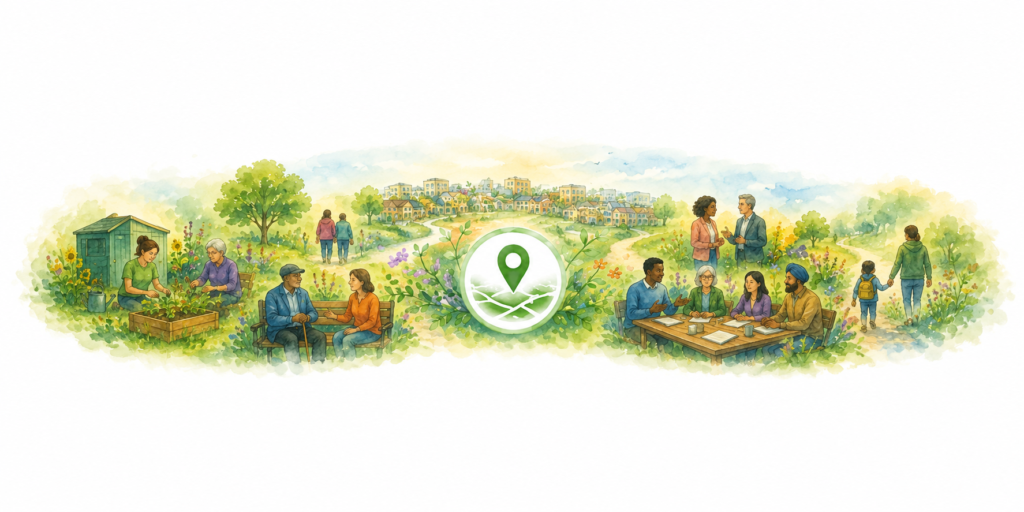
Co-production in action: aDoddle community maps
aDoddle is built around the idea that communities already hold much of the knowledge and support people need.
By bringing together clear, human descriptions of local support, it helps create a shared, visible layer of community information.
This makes it easier for:
- People to find help, opportunities to connect with others – helping to reduce isolation
- People to discover ways to get involved, including volunteering and community activities – for example through organisations such as Royal Voluntary Service (RVS) and platforms like GoVo (an organisation that we would love to collaborate and co-produce with)
- Organisations to be found and recognised for the support they offer
- Systems and decision-makers to better understand what already exists and what is happening on the ground, helping to reduce duplication and strengthen what is already working
In practice, this is what a #DoWith approach can look like – making it easier to connect what already exists, rather than starting from scratch.
The bigger picture
Co-production is not just about improving services – it is about changing how we think about them.
From:
- Designing for communities
To:
- Building with communities
This shift may seem simple, but it changes everything. It moves us away from isolated solutions and towards more connected, collaborative ways of working.
It helps create a shared, visible layer of understanding – making it easier to see what already exists, where the gaps are and how people and organisations can work together more effectively.
Over time, this kind of approach supports stronger, more joined-up systems, where effort is focused on strengthening what works, rather than duplicating what already exists.
A Gentle Invitation
Wherever you sit – in a community, an organisation, or a wider system – there is an opportunity to be part of this way of working.
To be part of building with people, rather than designing at a distance. To be part of a shift that moves beyond silos and towards something more connected, more human, and more effective.
At a recent Anthropy gathering at the Eden Project, where people from across sectors came together, there was a shared sense that something needs to change. That it is time to leave egos and silos at the door, and focus instead on what truly helps people and communities to thrive.
What made that space different was the opportunity to step away from set agendas and predefined outcomes, and instead:
To listen
To share
To connect
To be heard
Because stronger communities are not built in isolation – they are built together.
This is the opportunity that co-production offers. Not as a fixed model, but as an ongoing way of working that continues to evolve through conversation, collaboration, and shared understanding.
Please note:
A Note on How This Article Was Created
This article has been created and shaped by Jaki King, Founder and CEO of If Everyone Cares CIC – the organisation behind aDoddle.org and TheCommunityPledge.com.
It reflects more than 25 years of experience working in and alongside communities and over a decade of exploring community mapping, visibility and connection.
The content has also been shaped through listening to hundreds of real stories, insights and experiences shared by people, organisations and communities over time.
As part of the process, Jaki used AI as an accessibility and thinking tool to support how she works as someone who is dyslexic, autistic and has ADHD. This included helping her to structure ideas, refine wording and maintain clarity, while ensuring that the final content reflected her voice, her values and what matters in the work she does.
The article has been developed iteratively, going backwards and forwards to ensure it feels true to that.
(Time invested: approximately 5 hours from first draft to final version.)


